
For decades, the standard way to evaluate a media archive was strictly by scale and storage space. Production houses, broadcasters, and enterprise marketing teams looked at their media assets through a hardware lens: container formats, bitrates, codecs, and the total terabytes required to host passive video files.
The integration of advanced multimodal AI has fundamentally broken this paradigm.
Today, professional Media Asset Management (MAM) demands a shift in perspective. A video file is no longer just flat footage sitting quietly on a hard drive; it is a dense, multi-layered data package. Because a single hour of raw master footage contains an incredible, unindexed ecosystem of deep information, these assets have become a company’s most valuable intellectual property. Protecting this data is no longer a task for the IT teams—it is a matter of digital sovereignty.
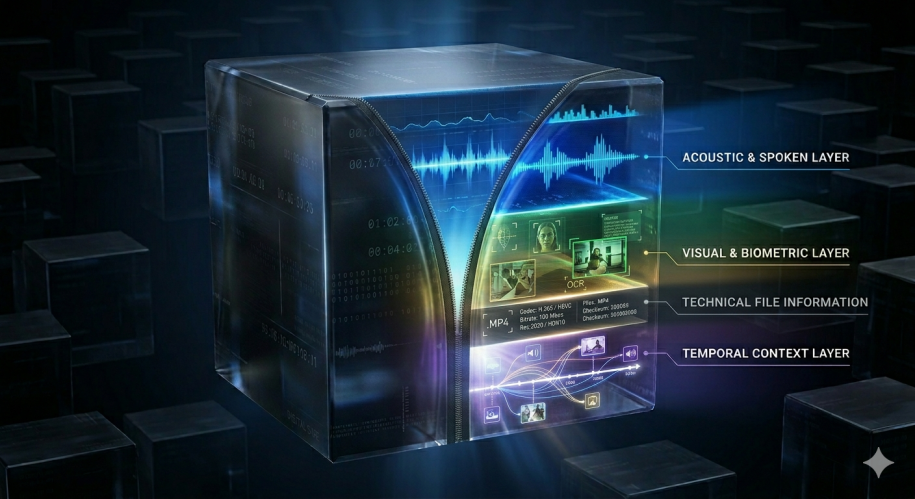
The Anatomy of Multi-Layered Media Data
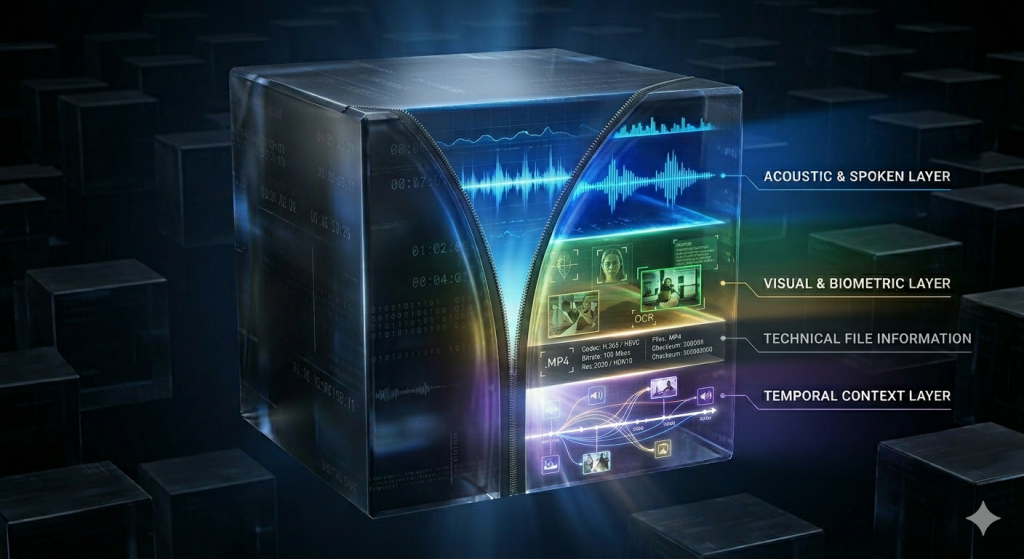
Modern media intelligence is built on the reality that any single asset contains parallel data streams that exist simultaneously. When unlocking media intelligence, these layers fundamentally change what an asset is worth, making it a highly sensitive asset:
- The Acoustic & Spoken Layer: Beyond standard verbal dialogue, this layer holds vocal inflections, background sound classification, environmental noise profiles, and distinct regional dialects.
- The Visual & Biometric Layer: Millions of individual frames containing facial biometrics, on-screen textual data (OCR), specific brand iconography, object detection, and precise lighting or environmental attributes.
- The Technical & Distribution Data Layer: This layer houses the essential DNA of the asset, including precise file formats, codec specifications, bitrates, and resolution data. It also integrates critical distribution metadata—such as packaging requirements, regional availability windows, rights management profiles, and automated supply chain routing instructions—that dictate exactly how and where the content can be legally and technically deployed.
- The Temporal Context Layer: The exact, frame-by-frame timecoded relationship linking a spoken keyword to a specific visual emotion, a camera angle change, or a scene transition.
Beyond the Surface: Accessing the Full Context of Your Media Archive
Historically, this massive richness of information was classified as “dark data.” Archives were essentially digital black holes. Deep logging required teams to screen footage manually in real time, typing superficial descriptions like “Wide shot of executive talking at a podium.” This process was slow, expensive, and limited searchability to the exact, subjective words the logger chose to type.
Artificial intelligence has flipped this workflow entirely. With advanced vision models and neural transcribers embedded into the core of the MAM database, the software doesn’t just store the binary data—it maps and contextualizes it.
This transitions the entire archive from simple keyword matching to deep semantic search. Instead of searching for basic file names or generic titles, media teams can query their system using highly complex, contextual parameters:
“Locate all B-roll clips where a person mentions ‘sustainability’ while walking through an industrial environment, featuring natural morning light and visible product branding.”
Digital Sovereignity is the only sustainable option
Since media assets hold this substantial level of deep intelligence, a crucial consideration for every organization is how and where it is processed.
Extracting these simultaneous layers of text, visual context, and biometric data requires continuous, heavy computational processing. If an enterprise routes thousands of hours of high-resolution video through third-party public cloud AI endpoints, it is doing more than just paying a compounding “token tax” for every single word transcribed and face tracked. It is actively sending proprietary data, internal strategies, and unreleased intellectual property outside its perimeter.
In the AI era, true digital sovereignty means maintaining absolute ownership over both the actual media files as well as the intelligence engines that read them.
Relying on public cloud infrastructure to unlock your archive creates a dangerous supply-chain dependency and opens the door to severe data exposure. Unlocking the immense richness of your media data should never require you to compromise your security, sign away your data rights, or pay a permanent subscription fee to a third party just to search your own intellectual property.
Secure your source, protect your data depth, and keep your intelligence local.
Read more about our local AI engine: The Flowcal AI HUB